





Making a drink is easy. Making it drinkable should be too.
There is a question that does not appear in any clinical guideline but that every Speech and Language Therapist and Dietitian working in dysphagia care knows the answer to.
How often do you see an empty glass or cup? Not half-empty. Not pushed to one side with two-thirds remaining. Empty.
The answer, for most practitioners, is rarely.
Thickened drinks have a compliance problem that the dysphagia community has lived with for a long time — acknowledged in practice, discussed at conferences, noted in patient records, and largely accepted as an unavoidable feature of modified texture care.
We think it is avoidable. And we think the evidence is straightforward.
You rarely see a finished thickened drink. Unless it’s a Slõ one. Because when favourite drinks have been thickened and still taste like favourite drinks, patients tend to finish them.
That’s not a marketing claim. It is a description of what happens when the thickening process stops compromising the drink.
The problem with powder thickeners
Powdered thickeners have been the category default for decades. But the clinical case for moving on is well established.
Consistency is the primary issue — the relationship between powder volume, liquid type, temperature, and elapsed time creates variability that is difficult to control reliably across a care team. IDDSI compliance requires precision; powder thickeners make precision difficult.
The second issue is palatability. Powdered thickeners alter the appearance of drinks — introducing cloudiness, graininess, and a texture that patients find off-putting. For a patient population already at elevated risk of dehydration, reduced intake is not a minor side effect. It is a clinical outcome.
Slõ Syrup addresses both. As a liquid drinks thickener it mixes cleanly, maintains clarity in most drinks, and delivers consistent viscosity with significantly less preparation variability. The preparation itself is three simple steps:
Add. Stir. Go Slõ.
Reproducible by every member of a care team. Reproducible at home by a patient or carer. And crucially — producing a drink that looks and tastes close enough to the original that patients are more likely to drink all of it.
The case for powdered ONS
The second half of this argument runs in the other direction — and it is equally important.
Oral nutritional supplements are a cornerstone of dysphagia nutrition management. The problem has never been the clinical case for ONS; it has been the format. Ready-to-drink supplements carry a higher cost per serving, cold-chain logistics requirements, and an artificial taste many patients find unpleasant.
The compliance challenge here mirrors the thickened drink challenge: a supplement that does not get finished is a supplement that is not working.
The NHS position on powdered ONS is clear (NICE NG22) — powder is preferred wherever clinically appropriate, for reasons of cost efficiency, shelf life, and logistical practicality. The direction of travel in commissioning reflects this.
Slõ Milkshakes+ sit precisely in that space.
High in calories and protein, they provide the highest nutrition per ml of all pre-thickened ONS. Flexible in preparation volume, and — returning to the principle above — genuinely palatable. Made with fresh cold whole milk and flavoured with natural ingredients.
A supplement that tastes like a milkshake is a supplement patients are more likely to finish.
Add. Shake. Go Slõ.
Three steps. Consistent preparation. A result that patients look forward to rather than tolerate.
Why both arguments belong together
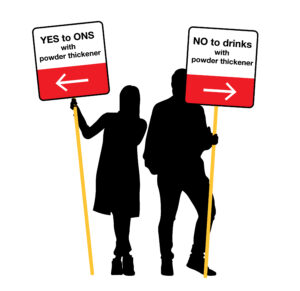
The apparent contradiction — saying no to one kind of powder while saying yes to another — resolves the moment you apply the same clinical standard to both.
In texture modification: the question is which approach produces the safest, most consistent, most palatable result.
Liquid thickeners answer that question better than powdered ones.
In nutritional support: the question is which format delivers the best clinical and economic outcome. Powdered ONS answers that question better than RTD.
Same principle. Different answers. Both of them in the interest of the patient finishing their drink.
Some powders belong in the past. Some belong in the now.
Samples
To order samples to try or for us to send direct to your patients click here>>
Questions we often hear
Why do patients not finish thickened drinks?
The primary reason is palatability. Powdered thickeners alter the appearance, texture, and taste of drinks — introducing cloudiness, graininess, and an off-putting mouthfeel. For a patient population already at risk of dehydration, reduced intake is a clinical outcome, not a minor side effect.
What is the difference between a liquid thickener and a powder thickener?
Liquid thickeners such as Slõ Syrup mix without lumping, maintain clarity in most drinks, and deliver consistent viscosity regardless of who prepares them. Powder thickeners vary in outcome depending on liquid type, temperature, stirring time, and the volume used — making precision difficult to impossible across a care team.
Does the NHS support powdered oral nutritional supplements?
Yes. NHS commissioning guidance favours powdered ONS over ready-to-drink formats wherever clinically appropriate, citing cost efficiency, longer shelf life, and logistical practicality.
Slõ Milkshakes+ are a powdered pre-thickened ONS designed to align with this direction.
What IDDSI level do Slõ products comply with?
All IDDSI Levels 1, 2 , 3 and 4. Rach batch of Slo Drinks is tested during production and randomly after production so clinicians, carers and patients can be confident the drink they make will match the Level prescribed.
Slõ Drinks has been developing dysphagia-friendly drinks in collaboration with Speech and Language Therapists and Dietitians since 2005.
